In many families, relationships are not only shaped by love and care, but also by patterns that quietly organize how everyone behaves and how each person is treated.
Sometimes these patterns form around a parent whose needs, emotions, and image become the center of the family’s universe. When this happens, the entire family can begin to revolve around protecting that person’s feelings, reputation, or authority.
I am not a psychologist, and I cannot diagnose anyone. But looking back on my childhood and the years that followed, I gradually began to recognize dynamics that are often described in psychology as narcissistic family structures.
In these families, roles tend to develop among the children. One child may become the favourite: the one who reflects well on the parent. Another may learn to stay quiet and invisible. And sometimes, one child becomes the one who carries the blame.
In my family, my mother’s personality and emotional needs shaped much of the atmosphere in our home. My father, in many ways, seemed to align himself with her, often accepting her version of events without question. When conflicts happened, the outcome was almost always the same: I was the one who was punished.
Over time, these repeated moments created a powerful message within the family: that I was the problem.
This section of the blog is my attempt to understand those patterns, not to assign labels with certainty, but to describe the roles that gradually formed and how they affected each of us.
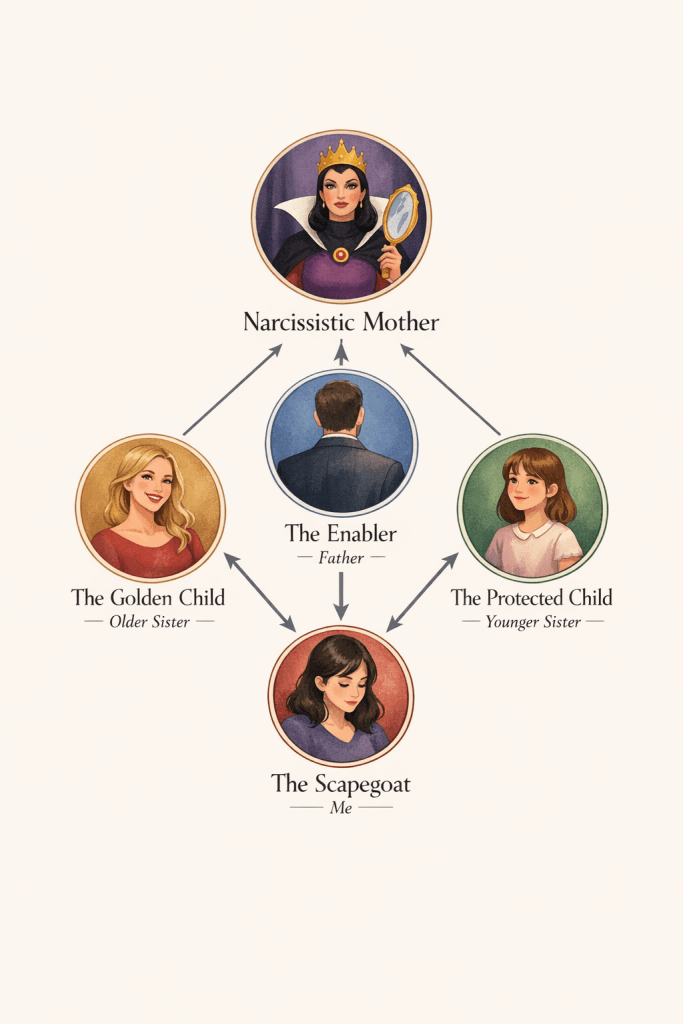
1. The Narcissistic Center
My so called mother
The emotional center of the system. The family organizes around her feelings, needs, and reactions.
2. The Enabler
My father
The person who protects or supports the narcissistic parent, often by:
- believing their version of events
- punishing the scapegoat
- maintaining the family narrative
3. The Golden Child
My older sister – S1
The child who reflects well on the parent and is rewarded for aligning with them. Golden children often:
- support the parent’s narrative
- distance themselves from the scapegoat
- gain approval by loyalty
4. The Protected/Late Child
My younger sister – S3
Characteristics often include:
- arriving later when the parents are older or more stable
- being shielded from earlier chaos
- not witnessing much of what happened
- defending the parents because their experience was different
It’s very common for the youngest child in these systems to say things like:
“That never happened.”
“You’re exaggerating.”
“Our parents weren’t like that.”
Not necessarily because they’re malicious, but because their reality was genuinely different.
And when someone’s identity is tied to believing the family was normal, hearing another sibling say otherwise can feel threatening to the
5. The Scapegoat
Me – S2
The child who carries blame for the family’s tension and problems. The scapegoat often:
- questions things
- reacts emotionally to injustice
- becomes the target of punishment
The scapegoat is often placed at the bottom of the structure, because all tension and blame flows downward.
One more important thing
The role of scapegoat is very often the person who later:
- questions the system
- seeks therapy or understanding
- writes or speaks about what happened
- breaks the family narrative
 🌱🏠 زیر پوستِ خانه